Mimosa, Memory, and the World’s Largest Scent Archive: Meeting Anne-Cécile Pouant of the Osmothèque - Part 2
Interview by Julia Arvanitakis (Perfume.Curious)
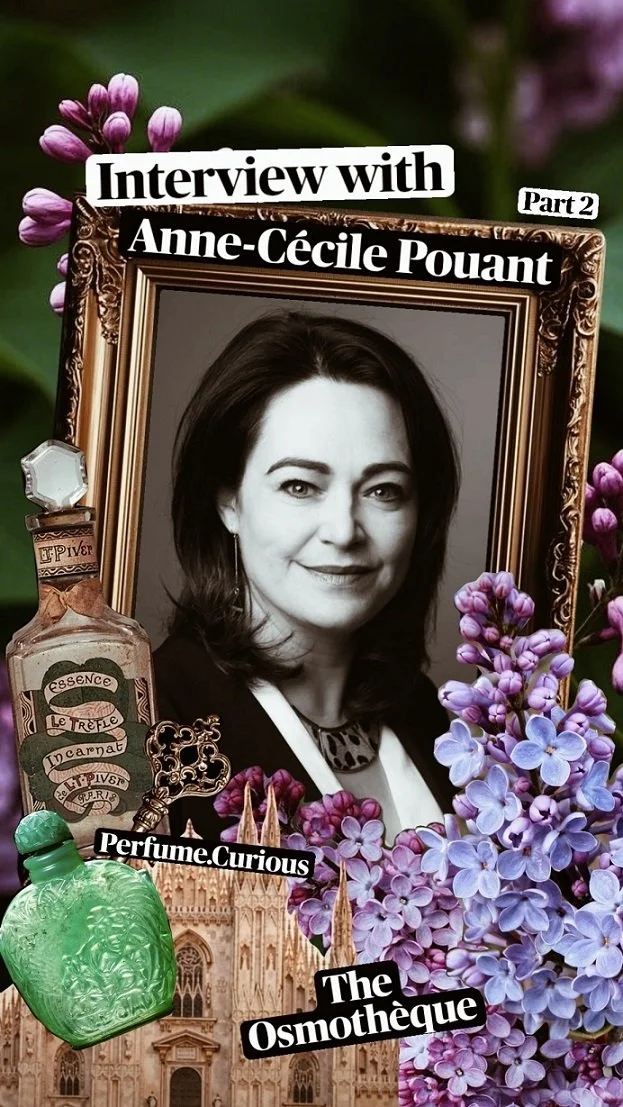
Anne-Cecile Pouant of the Osmothèque
“Traveling in the mind, in dreams, somewhere else. The sound of keys would later take everyone back to reality...”
If Part 1 was dedicated to the introduction of the story and Anne-Cécile Pouant’s view on the industry and the Osmothèque’s history, this time we are delving into Anne-Cécile’s personal experiences at the institution. To summarize what is the core purpose of the Osmothèque, we can revisit their three main missions in her words:
Preserve and develop the collection of perfumes, which is a heritage and a memory of the industry, but also a memory for people. I dare say it’s a heritage of humanity, because all over the world, people have memories that ring a bell with a smell. We preserve and develop it for future generations.
Share. If you are in a castle with your treasure and nobody can see it, is it even a treasure? We educate, train, and offer knowledge. We are not a school; it’s cultural perfumery, not an official diploma. Like a museum, we share with professionals, students, children, and the elderly. We even go to prisons or care homes, explaining, sharing, discussing history. The objective is always to give clues to understand “smell culture.”
Research to improve knowledge about the history and story of perfume, and about tomorrow’s history of the art of perfume. One of our missions is to preserve smells so that when perfumery is fully recognized as an art, we can illustrate its history through smell. Perfumes die if you don’t smell them. Unlike a painting, a perfume disappears in a few years. We preserve them, it’s our duty. It's a sort of crazy process, because even the one that is perfectly fresh, in 3, 4, 5, 10 years, they will be destroyed. We make perfumes live again to share them with people, just like those before us and after us.
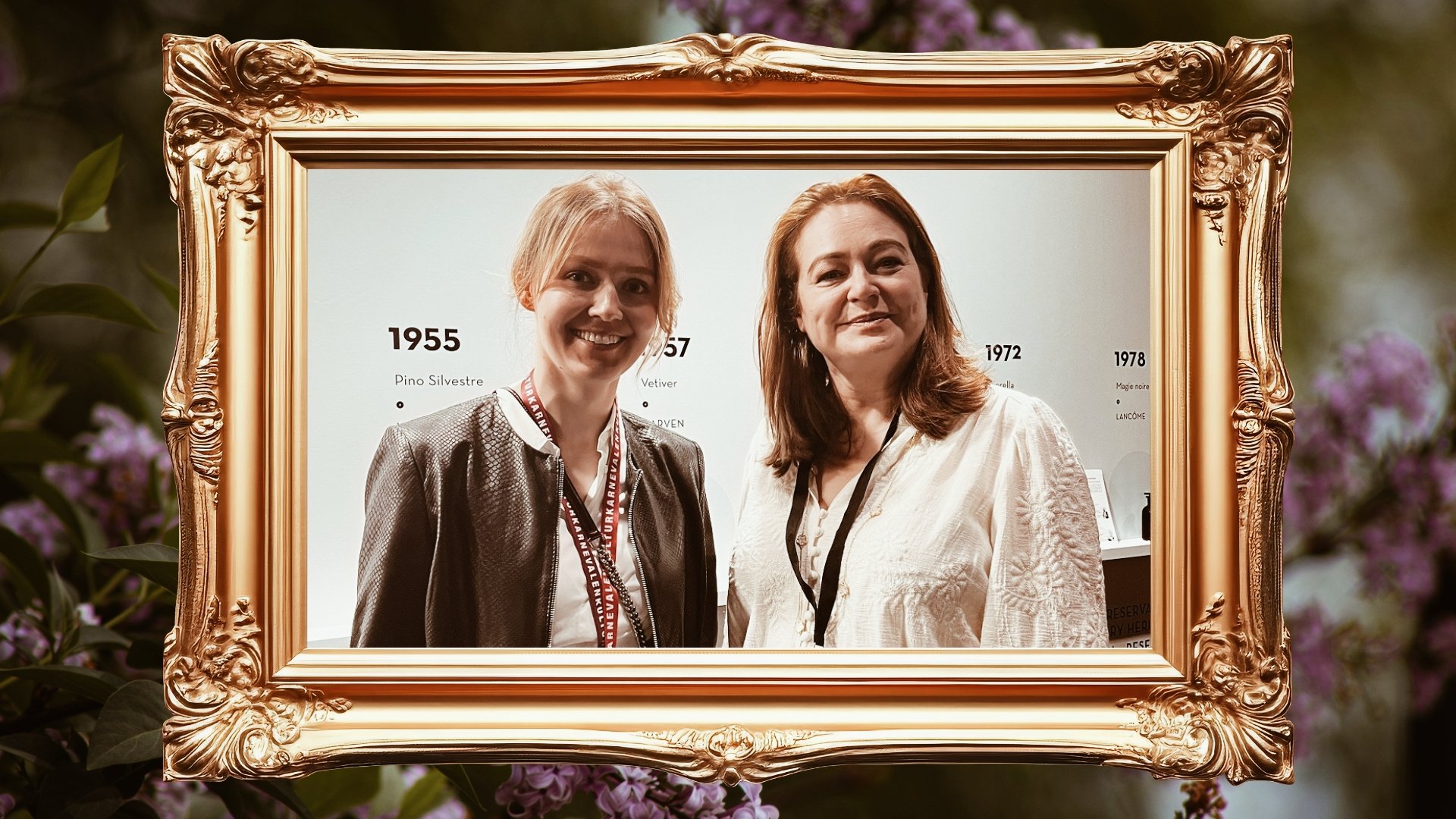
Perfume.Curious (Julia) & Anne-Cecile Pouant at the Osmothèque stand, Esxence 2024.
To be part of such an important cultural movement must leave a trace in your life, I thought. I was very curious to know: What is Anne-Cécile’s interest in her work? What were the moments that touched her the most?
“Mainly today it’s not very politically correct - it’s not, of course, to be the memory of an industry. It’s an interesting goal to preserve the heritage for future generations, great, but also to offer people the opportunity to live some very intense moments - rediscovering, going back to their youth, going back with their, I don’t know, first love, going back to the period, the first perfume that the woman wore when she was 18. We give life back to some period of your life or to some people. It’s not rare that we see, especially with older people, that some of them give us very interesting testimonies. For example: “You made my wife live again, smelling your perfume.” And that’s something so powerful. You have the opportunity to give back life to someone, and I find that it is an amazing power and a chance to offer this opportunity. This opportunity, in 99% of cases, gives people a smile, even if the older person cries because they remember their wife. It’s something happy; it’s a good memory, because our brain is very well designed. I’m convinced it focuses on good memories, and we forget everything which is bad. We never had someone saying, “Remember something awful? I don’t want it.” In 99% of cases, it’s something positive.”
Another story she shared with me was a quite unexpected. I would have never thought this was part of her job description. Somehow, my impression of the perfume industry was rather commercial, concentrating mostly on profit, consumer and market trends. I was aware that a non-profit organization like the Osmothèque have various cultural projects outside their location, but this was something very unusual to discover. While she tells it, I can see in her eyes how vividly she goes back to that moment:
“I got a lot of memorable moments and that’s the magical part of my work. I had the opportunity, when I started the job, to go to a women’s prison - women who have been there less than two years. It’s funny because it’s Woman’s Day today. My colleague Isabel and I went there, and the atmosphere was special: doors closed, old building, keys jangling like in a movie. We spoke with 20 women in a locked room for a cultural presentation dedicated to oriental perfumery, linked to an exhibition on oriental paintings in Versailles. We discussed amber notes, how amber perfumes are built, and the most iconic amber-oriental perfumes. It was like an “escaping moment” - a suspended moment, traveling in the mind, in dreams, somewhere else. The sound of keys would later take everyone back to reality, but for that moment, we were all outside the prison. It was a memorable experience.”
She continues, this time with a smile on her face:
“Another funny moment: during an open day, a six- or seven-year-old boy came and asked, “Can we make perfume with whale's poop?” I said yes. We went to the fridge, took real pieces of ambergris, and smelled it together. The boy was amazed: “Is it true we can make perfumes with that?” Young children also need to be educated. So that's a very important topic for the future, to educate children to open their minds. Thanks to the perfume, there are a lot of studies at the moment that show that it's exactly like taste, the smell, you need to educate it the most you can before the language appears. So you have to stimulate the sense of smell for children as soon as you can, because it will create a lot of connections in the brain.”
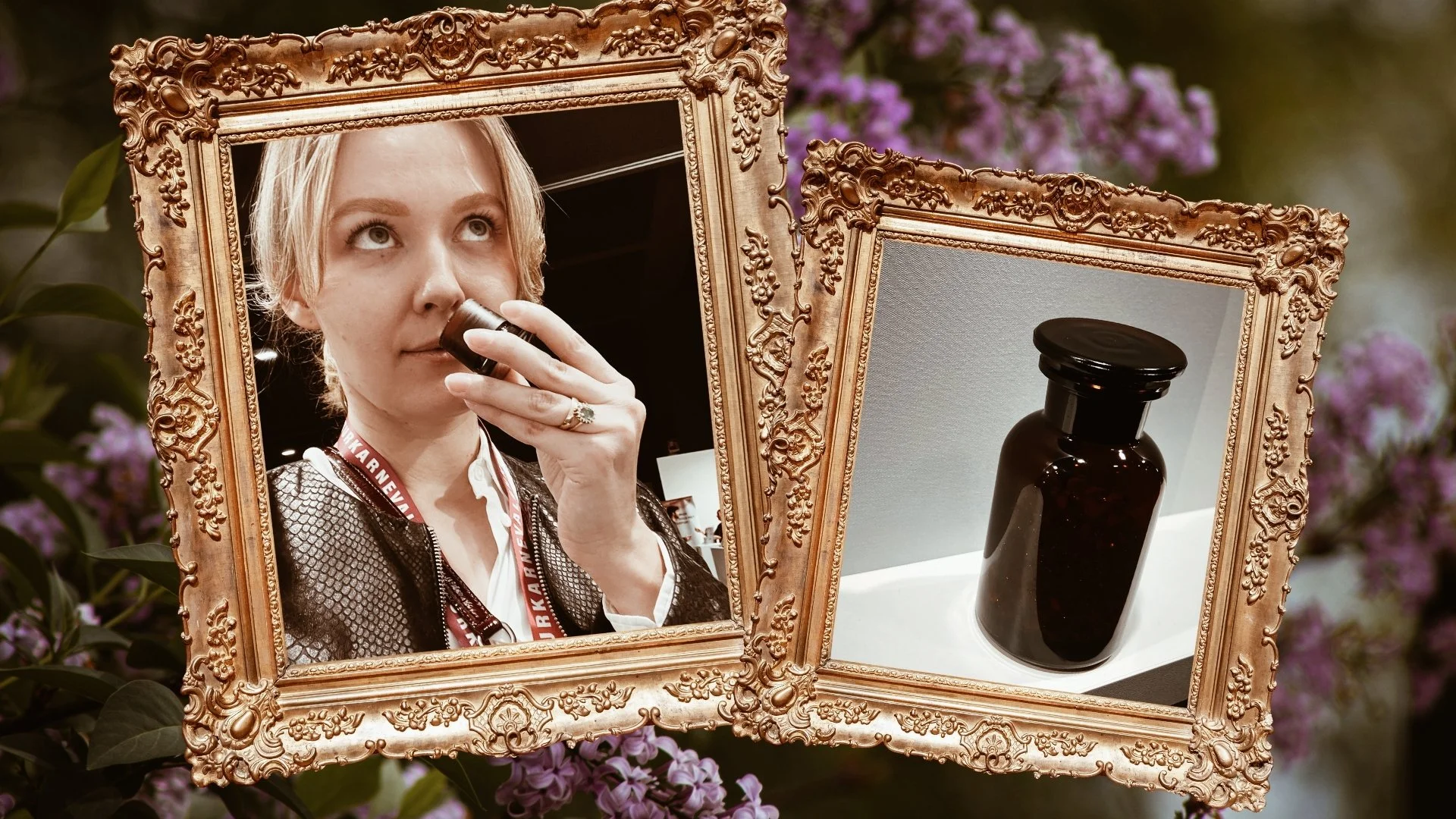
Sniffing original perfume formulas by the Osmothèque at Esxence 2024.
When re-listening the interview, I chuckled a little bit. It’s been a while since I had these types of funny interactions back at home, in Finland. After a long winter, I missed the lively Milan and its people. This reminded me again how significant cultural differences sometimes are - Nordic people tend to be more reserved, which also applies to their preferences in fragrances. I wanted to know whether Anne-Cécile has an opinion or story related to the topic.
I remember you mentioned your trip to Scandinavian countries, and about cultural differences in perfumery. Could you tell me a little bit more about that?
“We had two opportunities to go to Scandinavia, and I was very happy to be part of that, because it was totally new development for the Osmothèque. The first was an invitation by the National Museum of Sweden in Stockholm, thanks to our friend Victor Langer, who organized a presentation of the art of perfumery with the museum. We were proud that the first big event dedicated to perfumery as an art was directly in a museum - not an initiative of a private brand. Victor is passionate and will count in future research in perfumery. But what was very interesting is that it was in the National Museum. It means that the way to enter in the new country for us was directly as we dreamt to do. It means recognizing the perfume as an art. So we were very proud of that way to enter the country. It was not in a business and commercial way. It was in a cultural way. So that was a super experience. It was sold out in a few days, and there was a lot of crowd outside. They said they had never seen that. It showed a sort of cultural awakening. It was fantastic, and we were proud that the Swedish people immediately positioned perfume as an art and worked with representatives of this cultural heritage.”
“The second trip was the year after. We were invited by the French Institute in Copenhagen, thanks to a friend from Versailles who is passionate about perfumery. The Institute decided to focus on perfumes for the “Night of Creation”, equivalent to the Night of Museums. They offered us the opportunity to present perfume and give a lecture at the French Institute. It was an amazing experience. A friend, a French woman based in Copenhagen, created paper flowers. We decided to associate her flowers with perfume: we showed the flowers in winter, the raw material to smell, and a perfume containing that raw material. It was visually modest but very interesting. During the lecture, people discovered masterpieces and milestones of history. We were surprised, because people had very strong reactions. The Scandinavian taste was perhaps more discreet, soft, light. We collected testimonies: even if they didn’t like the perfume, they all had good memories. For example, one woman discovered a perfume that her grandmother once broke in the car. She said the car smelled wonderful her whole life. It immediately connected to her memories. It was funny, because it wasn’t the smell of the car - it was the perfume. We were surrounded by smells even if we don’t know it. Smell evokes memory, and it’s magical to be the trusted person witnessing this.”
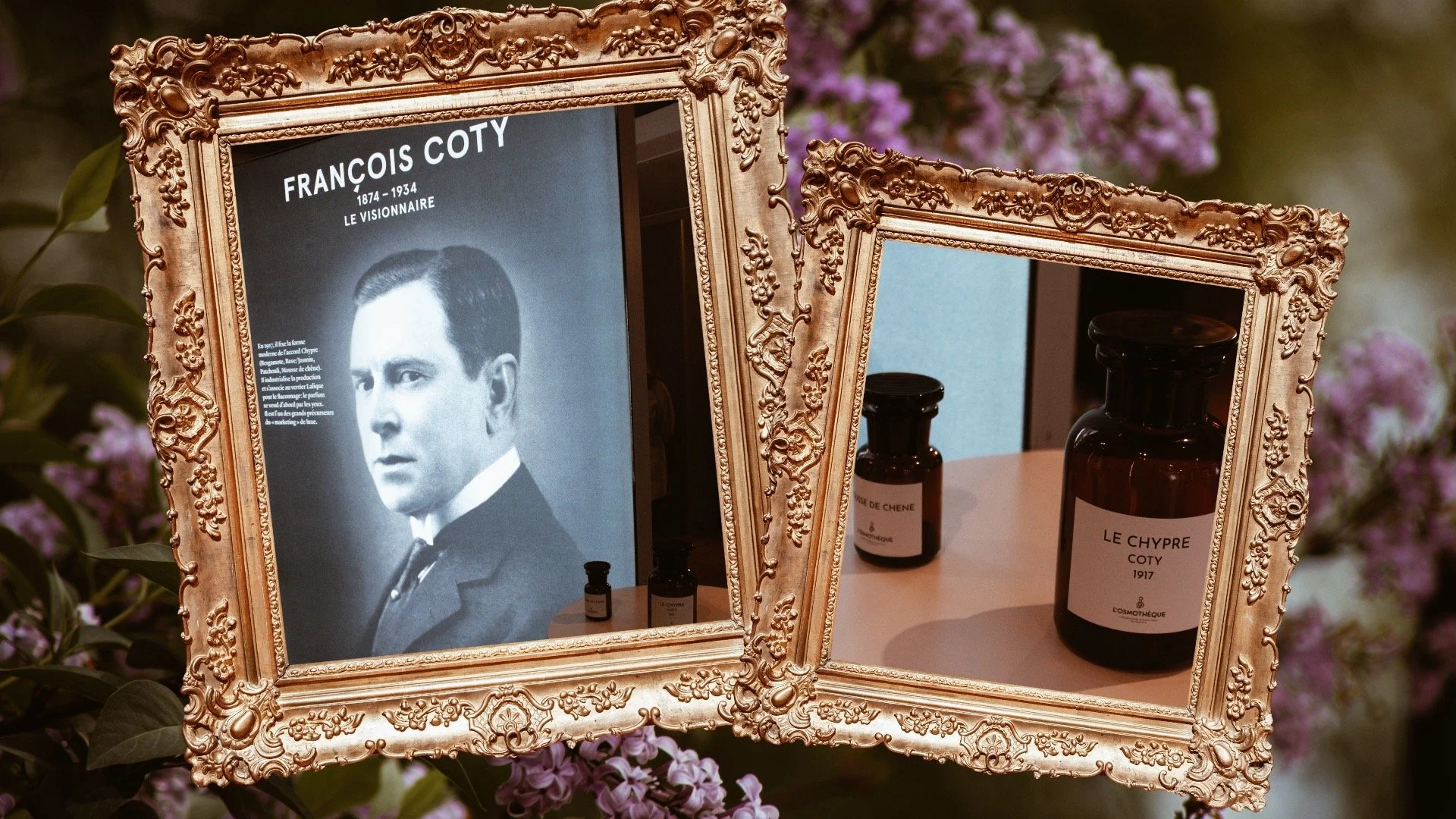
The Osmothèque exhibition at Paris Perfume Week 2026 - L’Empreinte des Maîtres: Francois Coty & Le Chypre
Reflecting back on my own experiences from childhood, I don’t recall any significant perfume memory. My mother didn’t really wear perfume, at least nothing significant I could associate with her, although there is a picture of us together, where I hold a blue Rive Gauche bottle by Yves Saint Laurent. Maybe it was an empty bottle? Speaking of which…
“And the last memory: one day I arrived at the Osmothèque, and the president explained the sad history of a perfume from the beginning of the Osmothèque - a very old perfume Trèfle Incarnat by L.T. Piver. They had been using it for years, and one day the bottle was empty, and we had no formula. It was lost. I said, “My mission is to have this perfume back in the collection.” It took three years to contact the owner of the brand, convince them, and finally we had it again. It was a long process! The day this perfume came back to the Osmotheque, I could quit, because I would have achieved the most complicated things that I had to do. And it was funny, because I had the call while I was at Esxence, at the exhibition, my phone rang, and it was the owner of the brand who said, look, okay, I will reduce. I associate that moment with Esxence. I said, Oh, I do not want to quit. So I had to find a new challenge, because it's too early. I wanted to stay some years more at the Osmotheque. So now I decided to create a new research of a lost perfume, and I'm working on it.”
Oh yes, I read about it in a magazine. Is it completely secret? Will it be revealed this year?
“The perfume I’m trying to recreate is a French brand called Roger & Gallet, associated with Eau de Cologne Extra Vieille de Jean Marie Farina. They had a wonderful perfume in the 1920s called Le Jade. Jade is a semi-precious green stone in Chinese culture. The bottle was typical Art Deco. I am sensitive to bottles; I spent a large part of my career in bottle design. The perfume disappeared; nobody knows exactly what it smelled like. Some people who collect the bottles have samples, I learned that it was a chypre perfume. I dream of rediscovering Jade, to redo it and to smell it as it did in 1923. That’s my next personal goal for the Osmothèque.”
It’s been two years since this discussion. I wonder whether Anne-Cécile has accomplished her goals and if her life has significantly changed. Mine surely has - bringing a new person into this world expanded my views and matured my character. Surprisingly, I came closer to my perfume goals too, although it has been a battle with time and energy management.
To conclude the story I leave you with the last question I asked her. Maybe it will open doors for you in the future too.
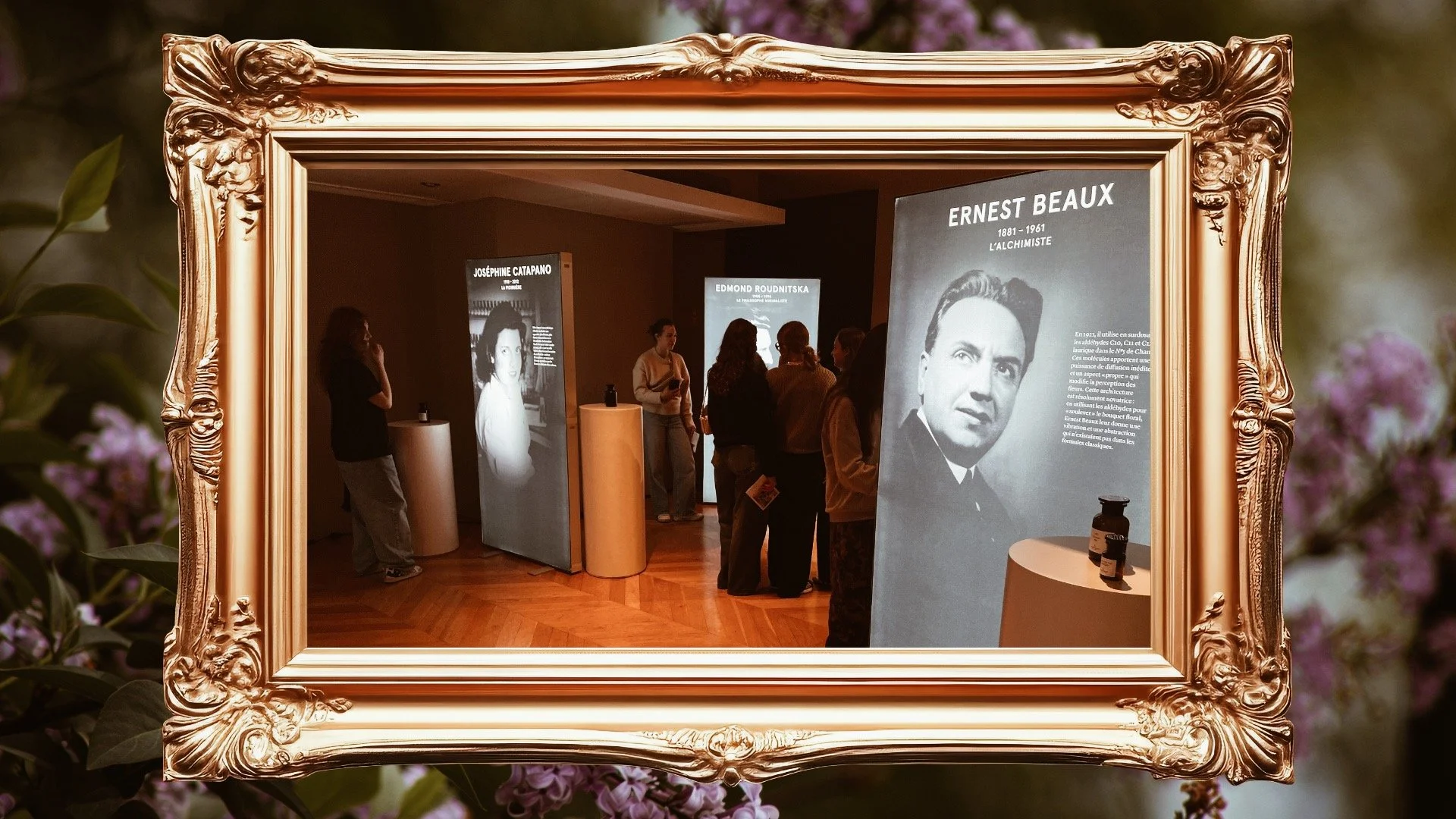
The Osmothèque exhibition at Paris Perfume Week 2026 - L’Empreinte des Maîtres
If someone is interested in perfumery, especially in vintage perfumes, what are the steps to move forward?
“The first step is to come to the Osmothèque and take an interest in history. There is no future if you do not integrate your past. Even if you plan to forget it, revolutionize it, or do something totally different, you need to know your roots. Strong roots make you stronger, armed for creating. There aren’t many museums of smell, so the Osmothèque is a reference. An interest in the past gives clues for comprehension. That’s my advice for people who want to learn more about the perfume industry, even today.”
Perfumes mentioned in Part 2:
Trèfle Incarnat - L.T. Piver
Eau de Cologne Extra Vieille de Jean Marie Farina - Roger & Gallet
Le Jade - Roger & Gallet
Rive Gauche - Yves Saint Laurent