Mimosa, Memory, and the World’s Largest Scent Archive: Meeting Anne-Cécile Pouant of the Osmothèque - Part 1
Interview by Julia Arvanitakis (Perfume.Curious)
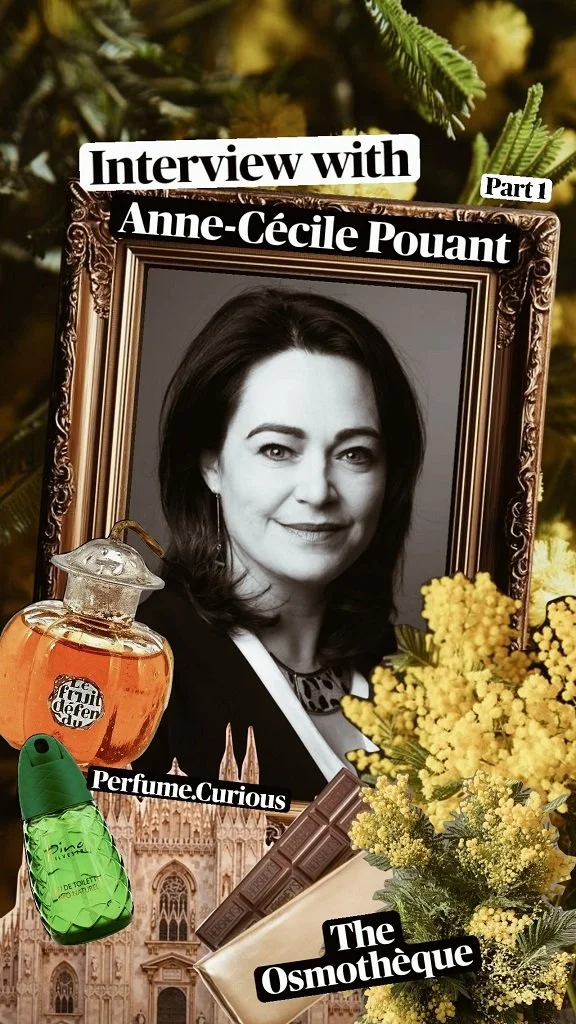
Anne-Cecile Pouant of the Osmothèque
“If you protect too much, it doesn't grow as it deserves.”
While I am writing this blogpost, I experience multiple emotions at once; gratitude, pride and relief. At the same time I feel slightly embarrassed by the fact that this process has taken me almost two years to reach this point. You might wonder what this has to do with anything. When I write my blogposts, they are often quite personal, exposing parts of myself, connecting memories deeply to scents; where they are not only part of the story but how everything evolves around them, anchoring a moment in time. This time, everything is connected to the scent of mimosa - a delicate flower, symbolizing sensitivity and renewal. I don’t believe in coincidences. In 2024, when this story and interview took place, what felt accidental at the time, now feels aligned and purposeful.
Today, on the 30th of March 2026, I’m wearing a vintage Eau De Charlotte by Annick Goutal - a sweet bouquet of yellow flowers and cacao. A prominent mimosa note takes me back to the early morning of 8th March 2024, International Women’s Day, the third day of Esxence - the international perfume exhibition.
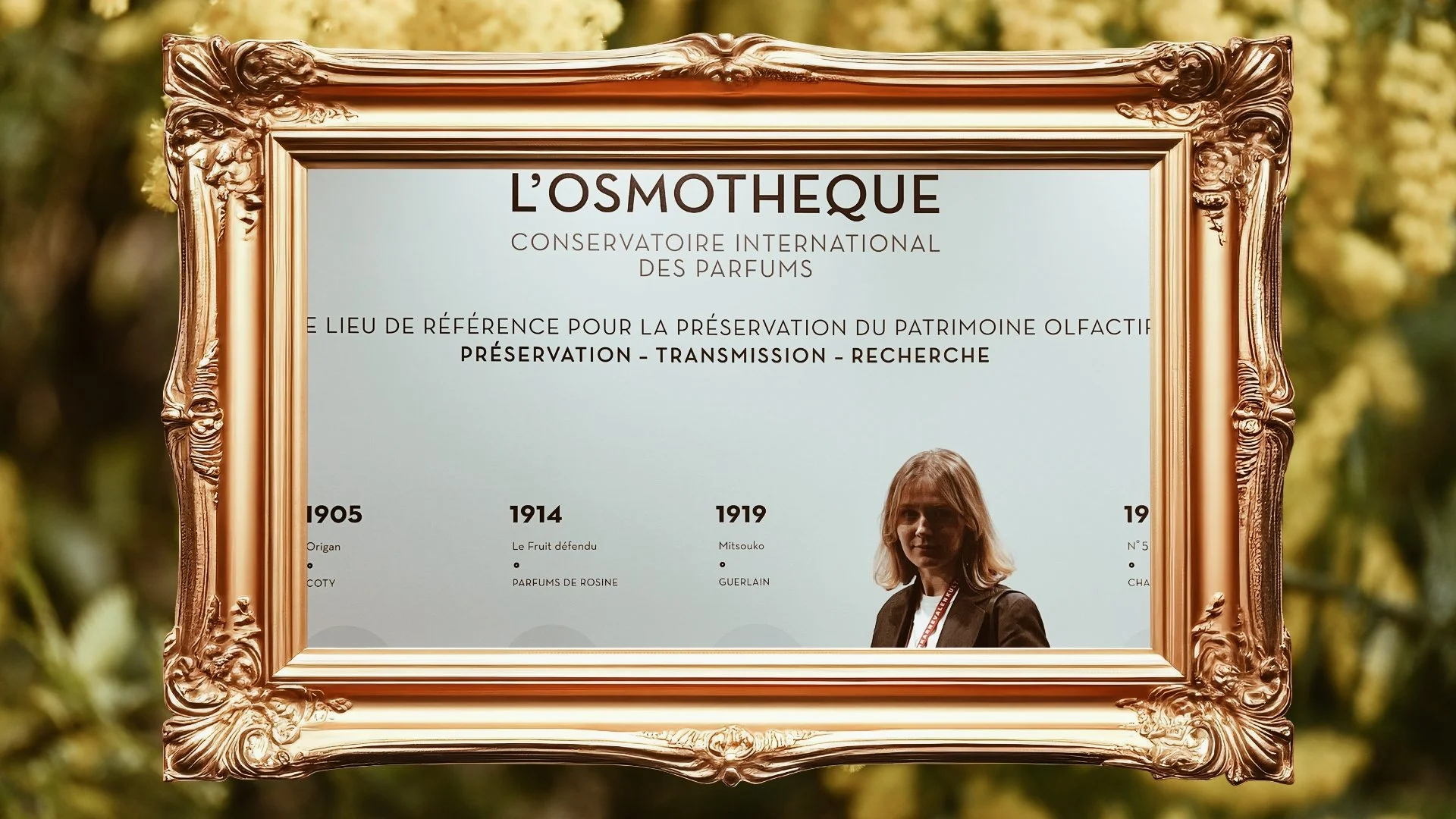
Perfume.Curious in front of the Osmothèque booth at Esxence 2024, Milan.
Just a few days ago, I arrived in Milan for Esxence as a total noob, with no previous knowledge or connections in the perfume world. One of my grand ideas was to find interesting topics and people to interview. There I was, standing at the center of a timeline wall, searching for the person responsible for an amazing stand that had captured my attention in the sea of hundreds of other presentations. I was directed to Anne-Cécile, a smiling woman, carrying herself with authority and confidence. Perhaps even slightly intimidating - the type of person I aspire to be. She agreed to meet me the next day for a longer conversation over breakfast at the hotel, where this story truly begins.
I’m sitting in the Meliá Milano hotel lobby, accompanied by a small mimosa bouquet, chocolate, and the anxious excitement I brought for Anne-Cécile Pouant, the Director of the Osmothèque, for our agreed interview. After doing some late-night “homework,” I realized that I was about to interview one of the key figures in the perfume industry, who I met by a complete accident. I guess curiosity didn’t kill the cat, but persistence brought her back.
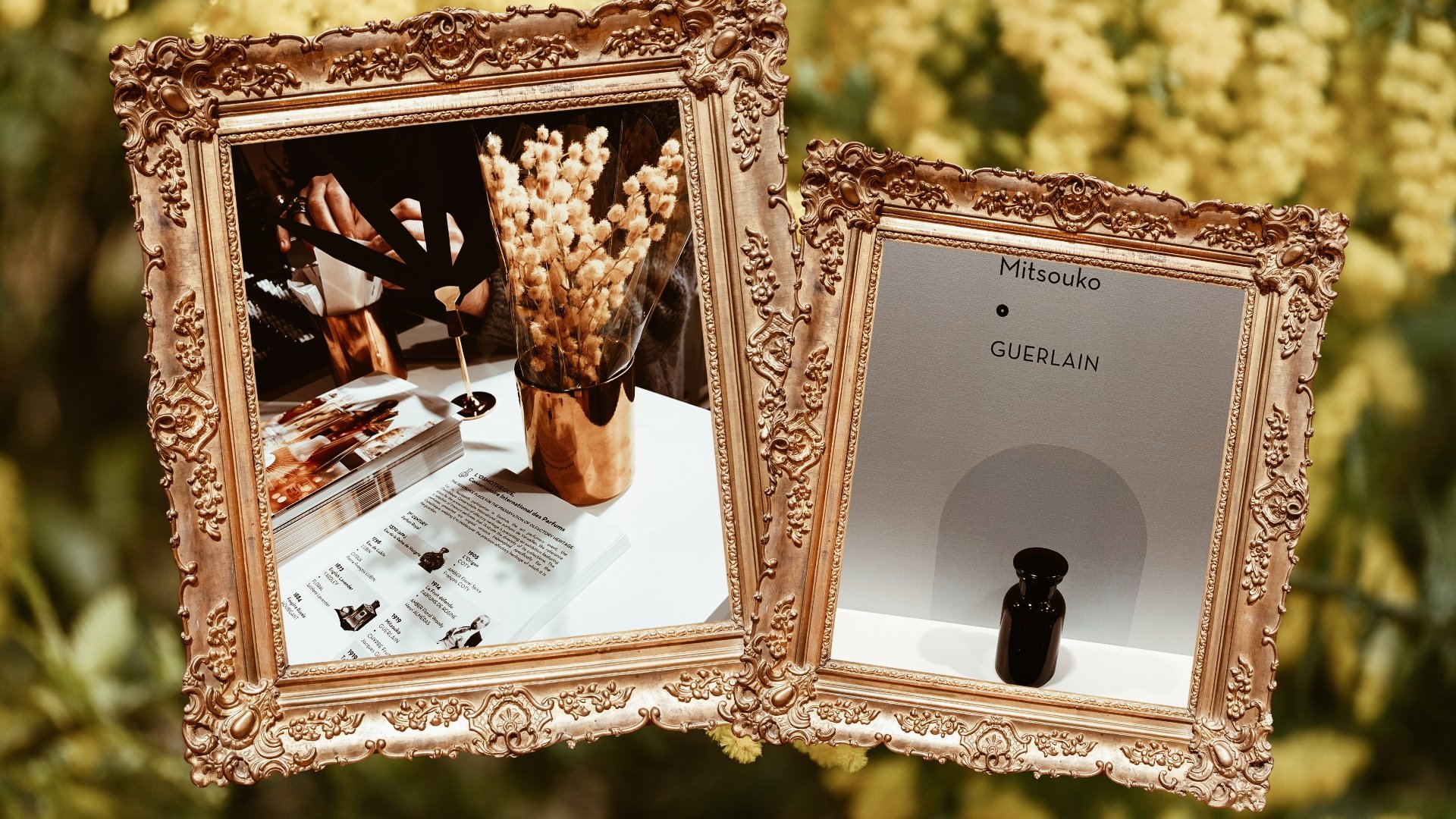
Mimosa branch at the Osmothèque stand & the original formula of Mitsouko by Guerlain presented as one of the significant perfumes.
I had a list of questions ready but it felt more natural to start a light conversation that eventually transformed effortlessly into a 45-minute long interview.
Anne-Cecile starts by introducing the origin of the Osmothèque:
“Osmothèque was created more than 35 years ago by perfumers. But in my opinion, it never really grew. It was never highlighted as the institution deserves. Because you know, perfumers have the habit of working in secrecy, and they are not businessmen. They are creative people. I think they were very proud of what they built, but they didn't know how to make it evolve, and they had a tendency to protect too much - the baby Osmothèque - and if you protect too much, it doesn't grow as it deserves.”
The Osmotheque, deriving from the Greek “osmè” (odor) and “theke” (storage), is a nonprofit organization and the first perfume archive in history, preserving and protecting the world’s fragrance heritage. Its collection contains over 6000 perfumes, of which around 800 are no longer available. Besides preservation, sharing and education are the main missions of the institute, located in Versailles, France.
“When I arrived - trying to find a new way to highlight the Osmothèque, to offer this cultural institution the place it deserves in the world of perfumery. It's not an easy goal, because the industry of perfumery, in my opinion, is not interested enough in its history.”
As a vintage perfume lover and collector, I was slightly surprised by people’s lack of interest in the roots of the industry. I always thought this was what perfumers learned when they entered those highly regarded schools. Anne-Cécile clarifies:
“Things are changing a little bit. I think there is a generation that we work with - a generation inspired by old perfumery. When you give them the opportunity to see and smell vintage perfume, they love that. But you need to convince them to take a break from their work and go back to the roots of their art. They are in a crazy rhythm of work. They are focused on the competition, trying to win the next project. So it's not obvious to have any daily interest in vintage perfumes.”
She continues:
“There is no art on Earth that doesn’t have an interest in its history and its past. If you want to build buildings, you have to know how architecture works and the history of architecture. If you want to paint, you have to study old paintings. That’s exactly the same in perfumery, and perhaps even more. You need to understand how it works, how it evolves, how perfumes of the past were built, why it's so different today. Just to be able to create for tomorrow - it gives you a lot of clues: There are twists, inspirations, small things that you can put in modern creations.”
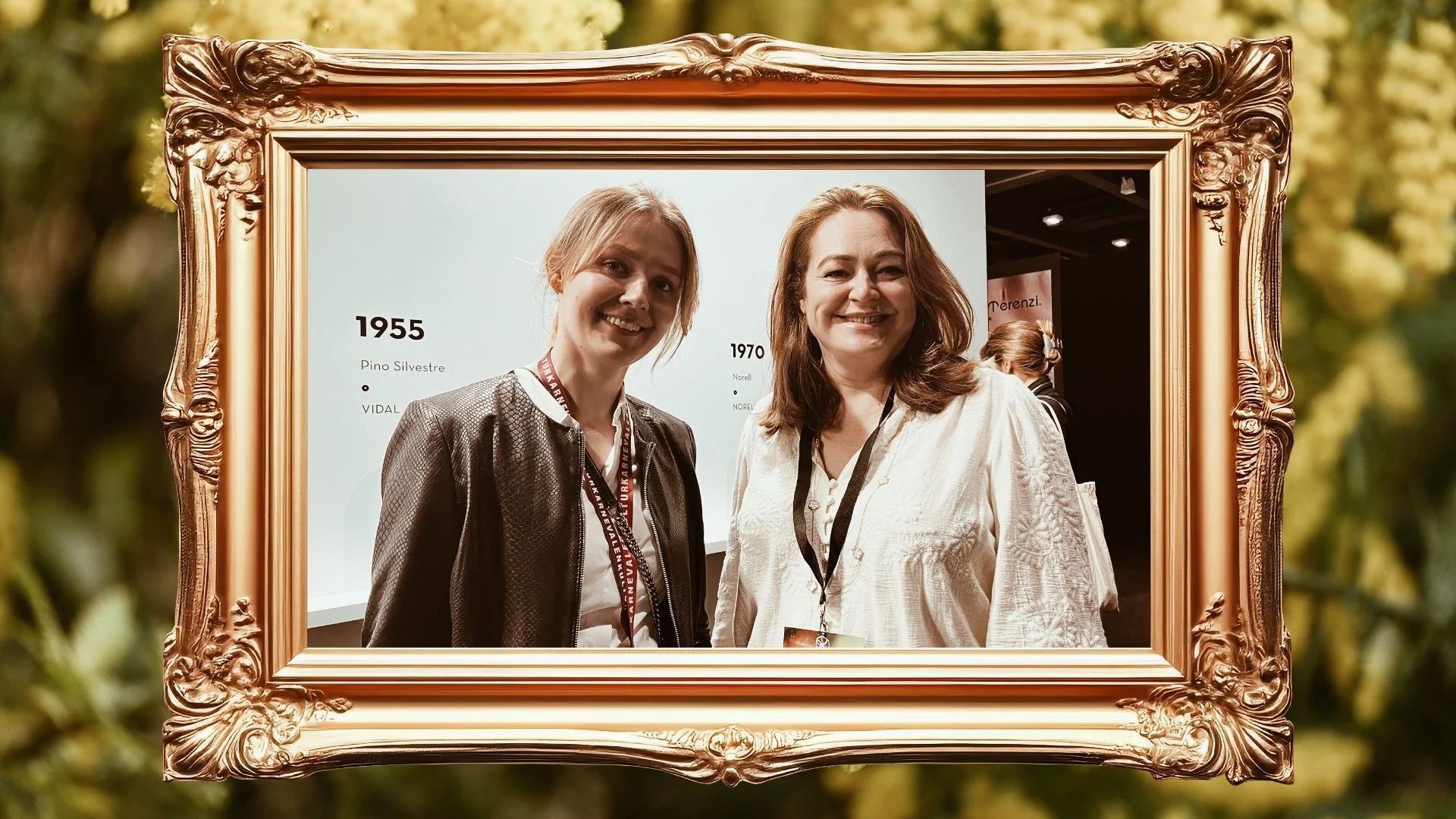
Perfume.Curious (Julia) & Anne-Cecile Pouant at the Osmothèque stand, Esxence 2024.
Besides professionals in the perfume industry, the Osmothèque has different audiences: general public, students and perfume enthusiasts. Anne-Cécile describes the process of perfume discovery as rather addictive, digging deeper and deeper in its history and knowledge. Exhibitions like Esxence attract larger audiences each year, especially on the days open to the public. The reason for such a high interest towards the Osmothèque is their position to provide an open access to historic and rare perfumes. Their team is composed of perfumers who you can meet while visiting the institution, providing insights behind the scenes of the perfume world.
Anne-Cécile describes one of her missions as focusing on young people who do not have any connections in the perfume industry; often where doors are closed.
“It’s not an easy world to integrate. That’s why we try to be a sort of link between the industry and a world of people who are passionate. One of my personal goals in running the Osmothèque is to pay attention to that, because it’s so frustrating for young people who want to know more and know nobody, to start a journey in the perfume industry. We have volunteers who offer training, and that’s part of my personal involvement in the Osmothèque, because the perfume world is still mysterious.”
In the very beginning, the Osmothèque was created by professionals for professionals, with an idea in mind to recreate perfumes as they were - using the original formula, not modern versions or interpretations, Anne-Cécile explains.
“Our name is “international archive,” but we must admit that we are a little French-oriented, because the period we focus on - which we call modern perfumery, starting in the 1880s until after World War Two - is the golden age. It was a period where we were introduced to synthesis in perfumery. It was also the age of couturiers (such as Chanel, Jean Patou and Lanvin) arriving to the perfume market. A large part of the collection is from this era.”
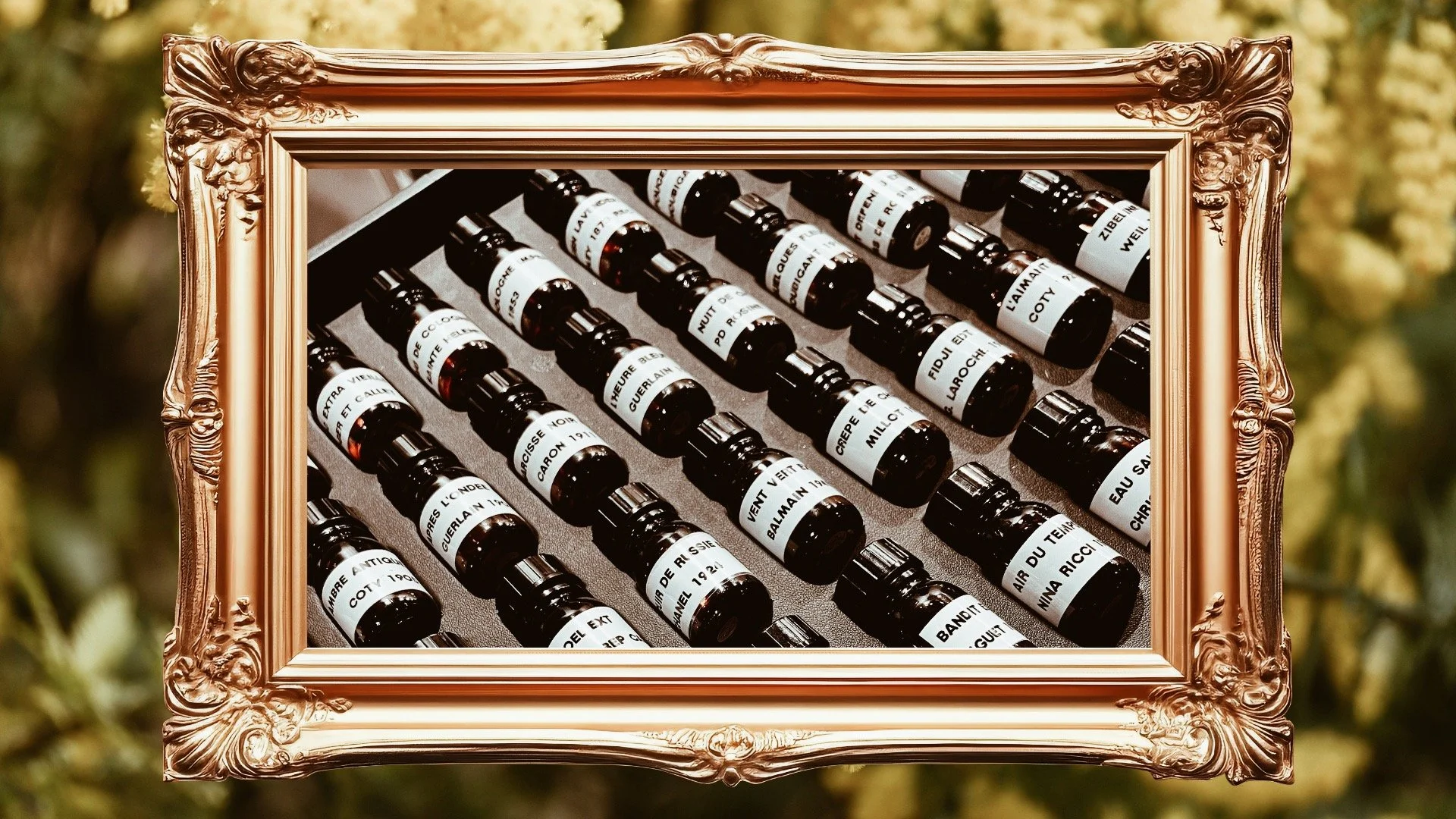
Original perfume formulas by the Osmothèque at Esxence 2024.
As part of my perfume journey, I started to be interested in how my favorite fragrances were made. Are these formulas open for the public, a regular person? - I asked her with a burning desire to obtain the knowledge on how my beloved Mitsouko was created.
“No, that’s the challenge. We need authorization from the owner of the brand, the heir of the brand, or the house of creation. At the very beginning, we started building a collection of formulas, like a National Library, to have a copy of all formulas and protect this heritage. Now it’s different. The formulas still remain secret, because there is no official protection. It’s not possible to patent a formula, so the only way to protect your creation is to keep it secret. It was very challenging to get authorization from the brand. It worked because at that time, the world of perfumery was smaller, and they focused on disappeared perfumes. Today, new formulas are entering our collection.”
“For old, disappeared perfumes, the last one we entered is Pino Silvestre, which you smell at the exhibition (at Esxence 2024). It’s an Italian brand, a very famous masculine perfume from the end of the 1950s. It totally disappeared in its original formula. The product is still on the market, but totally changed due to legislation. They offered us the formula at the Osmothèque, so we recreated this perfume exactly as it was in the 1950s - a different version from today, but a testimony for history. That’s very clever of them to accept that we recreate this perfume. Now, when we explain the evolution of masculine perfumery, for example, we have this reference. That’s exactly the idea of the Osmothèque: to smell history, to smell the evolution of the art of perfumery. That’s why we try to have as many perfumes as possible - not to write history, but to smell history. That’s our purpose.”
I was wondering, how are perfumes chosen for your collection? There are so many of them. How do decide which ones enter and what is the process?
“The official way to enter the Osmothèque is volunteer-based. There is no obligation. We ask the brand, and people give us the perfume. We do not buy perfumes for the collection. We ask the brand, based on the selection done by the French Perfumer Society, a selection of perfumes that they consider important - not for history per se, but for knowledge, for evolution, for the market. Maybe even for their purpose, which is not culture. Their purpose is to classify perfumes in the correct family and identify new or interesting ones. Because we were part of the French Perfumer Society at the very beginning of the Osmothèque, we still work with their classification. For the selection of perfume, we focus on their selection, and then we add some perfumes that we identify as interesting - perhaps because they won an award, perhaps because they are from a new brand with a very interesting positioning, or because they are very creative or created by a perfumer we would like to follow.”
Anne-Cécile continues to explain how historically speaking some perfumes were not popular at their time but are now considered as important milestones.
“Regarding disappeared or forgotten perfumes, we try to identify milestones in the history of perfumery. We don’t have all of them, some have disappeared for everybody. Some of them we are trying to track down. The last way to enter the collection is spontaneous donation. Many new brands are proud to offer perfumes to enter the collection of the Osmothèque. For them, it’s an honor to have a space in the official collection. Of course, we know that some perfumes will never be highlighted, but that’s the game. Perhaps in 10 or 15 years, we’ll be happy to go back to one of their creations. For example, Le Fruit Défendu (1918, Parfums de Rosine by Paul Poiret) - perfume you saw at the exhibition is by a perfumer Henri Almeras, the first gourmand fruity perfume in history. It had no success, but today it’s very interesting to see that perfumers were able to work in fruity, sugary, gourmand trends - even if it was too early and had no commercial success. So, this trend didn’t start in the 1990s, but just at the beginning of the century. Artistically speaking, some creators wanted to propose it, but it was too early. That’s exactly what is interesting in a conservatory or archive: we are not dedicated only to the success of perfumery, but also to identifying intentions 80 years ago, just like in art. Painters want recognition when they create; it’s the same.”
The day before, I was considering in which direction the interview could be guided. Since I had no prior knowledge on the Osmothèque or Anne-Cécile, except a short interview I managed to read from a magazine before going to sleep, I pondered in my mind, what was her personal experience at the institution? What did she find significant in her career?
These and many other questions were answered during the later part of the interview, which I will be introducing in the Part 2 in my blog soon.
PS:
Later on, I came to understand that the mimosa branch I brought to our meeting carried a special meaning in Italy. Gifting mimosa on Women’s Day signifies strength, appreciation, admiration, and respect toward the recipient. I hope that message came through during our interaction.
After following the Osmothèque’s activities from a distance during these two years, my appreciation for the work of Anne-Cécile and the team has grown significantly. I am more than excited to visit Paris Perfume Week in a few weeks, hopefully being able to visit the Osmothèque for the very first time, this time surrounded by familiar faces.
Perfumes mentioned in Part 1:
Eau de Charlotte - Annick Goutal
Mitsouko - Guerlain
Pino Silvestre - Pino Silvestre
Le Fruit Défendu - Parfums de Rosine (Paul Poiret)